

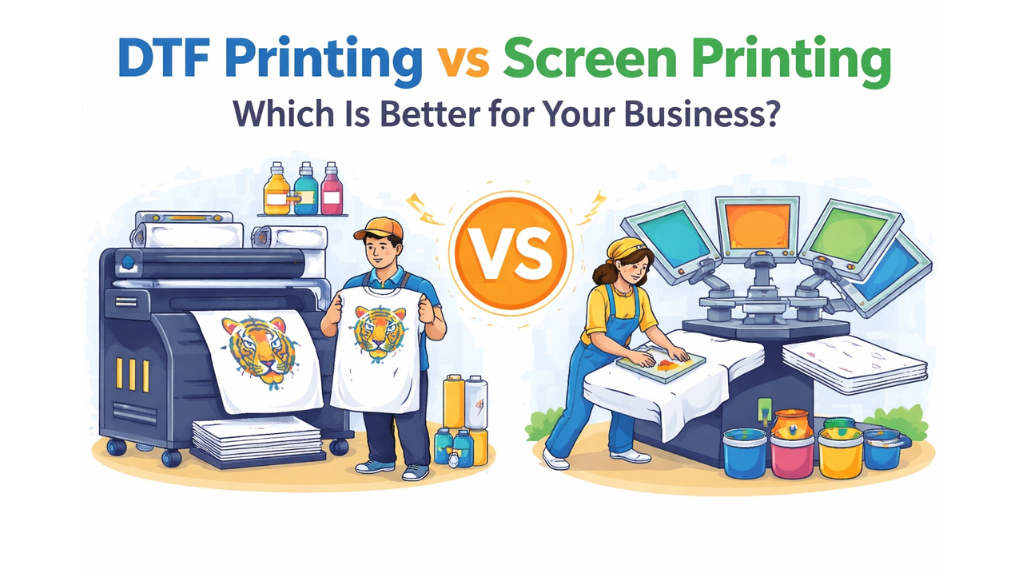
So you're ready to get custom t shirts australia businesses love : but you've hit a fork in the road. DTF printing or screen printing t shirts? Which one's actually going to work best for your business?
Whether you're kitting out your tradie crew, dressing your hospitality staff, or creating matching uniforms for your childcare centre, picking the right printing method can save you money, look more professional, and last longer in the wash.
Let's break it down in plain English so you can make the right call.
Screen printing is the OG of custom apparel. It's been around for decades and it's still one of the most popular methods for bulk orders.
Here's how it works: a mesh screen is created for each colour in your design. Ink is then pushed through the screen onto your garment, one colour at a time. The result? A slightly raised, textured print that's incredibly durable.
Screen printing t shirts is brilliant for simple, bold designs : think your business logo, a catchy slogan, or a one-colour graphic. It's the go-to for orders where you need hundreds (or thousands) of the same shirt.
DTF printing (Direct-to-Film) is the newer kid on the block : and it's shaking things up in a big way.
With DTF, your design is printed onto a special film, then heat-transferred onto the garment. The magic? It can handle unlimited colours, gradients, and photo-quality detail without any extra cost or setup.
DTF works on pretty much any fabric : cotton, polyester, blends, you name it. And it looks sharp on both light and dark-coloured garments without needing special preparation.
For businesses ordering smaller batches or designs with lots of detail, DTF is often the smarter choice.
This is where the two methods really start to differ.
Screen printing has higher upfront setup costs because each colour needs its own screen. That setup can take 1–2 hours before printing even starts. But once you're rolling, the per-unit cost drops significantly. For bulk orders : say 500+ shirts : screen printing becomes very cost-effective.
DTF printing, on the other hand, has minimal setup time (around 10 minutes). There's no screen to create, so you can go from artwork to finished shirt much faster. This makes it ideal for small to large orders : whether that's 10 custom polos for your café team or 200 hi-vis shirts for your construction crew.
Quick tip: If you're ordering small quantities or need different designs across your order, DTF is usually the better bet. If you're doing a massive run say x800 or more of the same design, screen printing will likely save you money.
Got a simple one-colour logo? Screen printing handles that beautifully.
But if your design has gradients, lots of colours, or photographic elements, DTF printing is where it's at. Since DTF prints from a digital file, it can reproduce complex artwork without any additional costs : no matter how many colours are involved.
Screen printing charges per colour, so a design with 6+ colours can get pricey fast. DTF doesn't care if your design has 3 colours or 300 : the cost stays the same.
For Australian small businesses, this is a game-changer. You can get vibrant, full-colour branding on your uniforms without blowing your budget.
Not all printing methods play nice with every fabric.
Screen printing works best on cotton and cotton-blend fabrics. It can struggle with synthetics and requires more preparation for dark garments.
DTF printing is far more versatile. It adheres well to cotton, polyester, nylon, and blends : making it perfect for everything from standard tees to performance wear and hi-vis workwear.
If your team wears a mix of different garment types, DTF gives you flexibility without sacrificing quality.
Let's be real : your staff uniforms are going to cop a beating. They'll be washed weekly (at least), worn in all conditions, and need to still look professional months down the track.
Screen printing is known for exceptional durability. The ink bonds deeply with the fabric fibres, creating prints that can last years without fading or cracking. The finish has a slightly raised, textured feel that many people love.
DTF prints sit more smoothly on the fabric and feel softer to the touch. With proper care, they hold up well over time : though they may show slight texture changes after many washes. They're less prone to cracking than some other transfer methods.
Both methods deliver quality results. Screen printing edges ahead for longevity in demanding environments (tradies, we're looking at you), while DTF offers a more comfortable feel for customer-facing roles.
Let's make this easy. Here's a quick guide based on who you are:
You need tough prints that survive job sites, sun exposure, and constant washing. DTF printing is your friend for large crews with a simple logo. But if you want detailed artwork (like a full-colour truck graphic on the back), DTF handles that brilliantly.
Staff turnover means you're often ordering smaller batches. Plus, you might want different designs for front-of-house vs kitchen staff. DTF printing gives you the flexibility to order what you need, when you need it.
Bright, colourful designs that appeal to kids? Check. Orders that might include kids' sizes, adult sizes, and different garment types? Check. DTF is usually the winner here for its versatility and vibrant colour output.
At ZZZZ BEST TEES, we offer both printing methods : so we can recommend the best option for your specific order. No pushy upsells, just honest advice on what'll give you the best result for your budget.
Ready to get started? Request a quote and we'll help you figure out exactly what you need. Or check out our printing technology page to learn more about how we do things.
